10 Acting Exercises You Can Do Alone (No Class Required)
Acting is a collaborative art. But most of your growth happens alone: in your apartment, on your commute, in the minutes between auditions. The best actors are the ones who've figured out how to train without a class, a stage, or a scene partner.
Here are 10 exercises that build real acting skill, require zero equipment, and work for actors at any level.
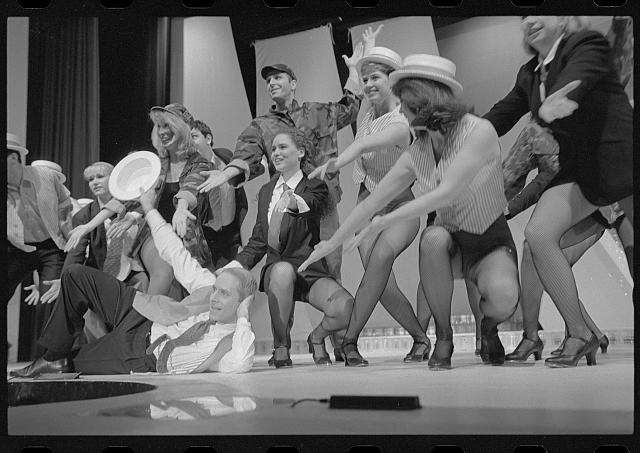
Performers on stage at the Hexagon Theater. Library of Congress. Public domain.
1. The Cold Read
Time: 10 minutes | Builds: Sight-reading, instinct, cold audition readiness
Pick up material you've never read before. A play, a screenplay, sides from a casting site, anything with dialogue. Read it out loud, in character, on the first pass. No prep. No analysis. Just go.
The goal isn't a good performance. It's comfort with discomfort. Cold reading is a muscle. The more you do it, the faster you make choices, the more confident you become with unfamiliar material.
Level up: Run the cold read with a scene partner so you're responding to actual cue lines, not just reading into empty air.
2. The Observation Exercise
Time: 15 to 30 minutes | Builds: Specificity, character creation, empathy
Go somewhere public: a coffee shop, a park, public transit. Pick one person. Watch them for a few minutes (without being creepy). Notice:
- How do they hold their body?
- What's their tempo? Fast, slow, restless, still?
- What might they be thinking about?
- What's their relationship to the space they're in?
Then go home and become them for 5 minutes. Walk like them. Sit like them. Speak an imaginary phone conversation as them.
This exercise builds the foundation of all character work: the ability to observe human behavior with specificity and translate it into your body.
3. Emotional Transitions
Time: 5 minutes | Builds: Range, emotional access, versatility
Pick two contrasting emotions: joy and grief. Anger and tenderness. Fear and calm.
Set a timer for 60 seconds. Start in emotion A. Let it fill your body completely. At 30 seconds, begin transitioning to emotion B. By 60 seconds, you should be fully in B.
The transition is the exercise. In real acting, you're rarely asked to play one emotion. You're asked to move between them, often in a single scene. This exercise trains the emotional gear-shifting that makes performances feel alive.
Key: Don't fake it. Don't indicate. Actually access the feeling. If joy means thinking about your dog, think about your dog. If grief means a specific loss, go there. The exercise only works if the emotions are real.
4. The Sense Memory Workout
Time: 10 minutes | Builds: Sensory awareness, emotional truth, presence
Sit in a quiet room. Close your eyes. Recreate a specific sensory experience from memory:
- The heat of a summer sidewalk under your bare feet
- The smell of a specific kitchen
- The texture of a specific piece of clothing
- The sound of rain on a specific roof
Don't just think about it. Try to feel it in your body. Can you actually feel the heat? Can you actually smell the kitchen?
Sense memory is the engine of emotional truth in acting. When your character is cold, you don't "act cold." You recall what cold actually feels like in your body. This exercise sharpens that ability.
5. The Monologue Workout
Time: 15 to 20 minutes | Builds: Sustained performance, text analysis, emotional stamina
Take a monologue you know well. Run it three times, each with a different given circumstance:
- You're confessing to your best friend. Intimate, vulnerable, close.
- You're addressing a jury. Public, persuasive, high-stakes.
- You're talking to someone who's about to walk out the door. Urgent, desperate, unfinished.
Same words. Three completely different performances. This exercise proves that text doesn't determine performance. Context determines performance. The words are just the vehicle.
6. The Listening Exercise
Time: 10 minutes | Builds: Active listening, responsiveness, presence
Put on a podcast interview. Not fiction, a real conversation between real people. Close your eyes and listen to one speaker as if they're talking directly to you. As if you're about to respond.
Notice what happens in your body when they say something surprising. Notice the impulse to respond. Notice what you feel before you have words for it.
Now run a scene with a reader and bring that same quality of listening to the other character's lines. Most actors listen with their ears in rehearsal but their ego in performance, waiting for their cue instead of being affected by what's said. This exercise retrains the habit.
7. Physical Character Work
Time: 10 to 15 minutes | Builds: Physicality, character transformation, body awareness
Stand in front of a mirror (or don't, since mirrors can make you self-conscious). Find your neutral posture. Then systematically alter:
- Center of gravity: Lead from your chest. Now your pelvis. Now your forehead. How does each change the way you move?
- Tempo: Move at half speed. Now double speed. Now switch between them.
- Tension: Carry tension in your shoulders. Now your jaw. Now your hands. How does each tension pattern change who you become?
Every character lives in a body that's different from yours. This exercise builds your vocabulary of physical choices so you're not just performing from the neck up.
8. The Substitution Exercise
Time: 10 minutes | Builds: Emotional availability, personal connection to text
Take a scene where your character is in conflict with someone. Instead of imagining the fictional other character, substitute a real person from your life, someone who triggers a similar emotional response.
If your character is trying to get approval from a cold father, think of the person in your life whose approval you've sought. If your character is being betrayed, recall someone who let you down.
You're not reliving trauma. You're borrowing emotional resonance to fuel fictional circumstances. The audience sees the character. You feel the truth.
Important: This is a tool, not therapy. Use it to access emotion, not to process personal issues. If a substitution is too painful, choose a less charged one.
9. The "What If" Game
Time: 5 to 10 minutes | Builds: Imagination, stakes, creative play
Take any mundane activity (making coffee, checking your phone, walking to the door) and play it under an imaginary circumstance:
- What if you're making coffee and the person sleeping in the next room doesn't know you're leaving forever?
- What if you're checking your phone and the message you're waiting for will tell you whether your mother is alive?
- What if you're walking to the door and there's someone on the other side you haven't seen in 20 years?
The activity stays the same. The stakes transform everything. This exercise trains your imagination to generate the inner life that makes ordinary moments extraordinary, which is exactly what screen acting demands.
10. The Daily Scene Run
Time: 15 minutes | Builds: Everything
The single best daily practice for any actor: run one scene you've never worked on before. Every day.
- Pick unfamiliar sides (casting sites, play anthologies, screenplays online)
- Run the scene with a reader or record the other lines
- Don't prep. Don't overthink. Just run it.
Over a month, that's 30 scenes. Over a year, 365. The cumulative effect is enormous: your cold reading improves, your instincts sharpen, your range expands, and your audition nerves decrease because performing becomes routine.
This is the exercise that replaces what actors used to get from daily rep theater: the sheer volume of performance that turns acting from something you do into something you are.
The Compound Effect
None of these exercises will transform your acting overnight. But 15 minutes a day, consistently, compounds into something significant. In six months of daily cold reads, you'll walk into auditions with a fundamentally different level of confidence and readiness.
The actors who book aren't the ones waiting for the next class or the next audition to practice. They're the ones who practice between.
Run daily scenes with a scene partner →
Image courtesy of the Library of Congress, Prints & Photographs Division. Public domain.