How to Deal with Audition Nerves (And Why They're Not the Problem)
Your hands are shaking. Your mouth is dry. You can feel your heartbeat in your throat. You're sitting in a waiting room full of actors who all look more confident than you, and your brain is screaming: I'm going to forget everything.
Sound familiar? Good. It means you care. And that's not the problem. It's the starting point.
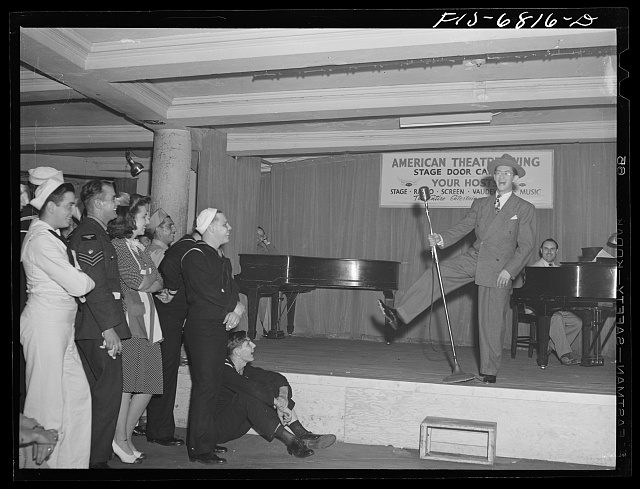
Broadway performers at the Stage Door Canteen, New York City, 1943. Every night, no excuses. Library of Congress, FSA/OWI Collection. Public domain.
Why You Get Nervous (The Biology)
Audition nerves aren't a psychological flaw. They're a biological response. Your amygdala, the part of your brain that detects threats, treats "being evaluated by strangers" the same way it treats "being chased by a predator."
The result: adrenaline, cortisol, elevated heart rate, tunnel vision, dry mouth. Your body is literally preparing you to fight or run. It doesn't know you're just reading sides.
Here's the reframe that changes everything: Those physical symptoms (racing heart, heightened senses, surge of energy) are the exact same symptoms as excitement. The physiology is identical. The only difference is the label your brain attaches.
Research from Harvard Business School found that people who reframed anxiety as excitement performed significantly better than those who tried to calm down. "I'm excited" works better than "I'm not nervous."
The Real Source of Audition Anxiety
Nerves aren't random. They come from three specific sources:
1. Fear of Forgetting
You're afraid you'll go blank. This fear is almost entirely a preparation problem. When you've run lines enough that they're in your body, not just your head, the fear of forgetting drops dramatically.
The fix: Run lines with a reader until you can do the scene 3 times in a row without looking at the script. Not once. Three times. That's the threshold where muscle memory takes over.
2. Fear of Judgment
You're afraid of looking bad in front of strangers. This is the deepest fear and the hardest to shake. But here's what working actors know that beginners don't: casting directors are rooting for you.
They're not sitting there hoping you'll fail. They need you to be good. They've been watching tapes all day and they're praying you'll be the one who nails it so they can move on to the next role. You're not on trial. You're the answer they're looking for.
3. Fear of Outcome
You want the role. You need the role. The stakes feel enormous. And that pressure turns the audition from a creative act into a test you might fail.
The paradox: The actors who book most consistently are the ones who've learned to detach from the outcome. Not because they don't care, but because they've done enough auditions to know that booking is a numbers game. You do your best work, and you let go.
7 Techniques That Actually Help
1. Prepare More Than You Think You Need
The #1 cure for audition nerves is preparation. Not positive thinking. Not deep breathing. Knowing the material cold. When you've run lines 10 times instead of 3, your confidence isn't fake. It's earned.
Pressure eats about 20% of your preparation. So prepare to 120%.
2. Warm Up Your Body
Nerves live in your body, not your mind. Before an audition:
- Shake out your hands and arms for 30 seconds
- Roll your shoulders and neck
- Do 10 deep breaths (in for 4, hold for 4, out for 6)
- Hum to warm your voice
You're not trying to relax. You're trying to move the nervous energy from frozen tension into available energy. Actors who warm up before auditions consistently report feeling more grounded.
3. Burn the First 10 Seconds
The first 10 seconds of any audition are the scariest. After that, you settle in. Knowing this is power.
Prepare your slate and your first beat extra-carefully. Have your "moment before" locked in. If you can get through the first 10 seconds with confidence, the rest follows.
4. Focus on the Other Character
This is the single most effective audition technique, period. When you walk into the room (or press record on your self-tape), put all of your attention on the other character. Listen to them. React to them. Let their words affect you.
Why this works: self-consciousness is the enemy of good acting. When you're focused on yourself (how you look, how you sound, whether you're good enough), you're not acting. You're monitoring. The moment you shift focus to the other character, the monitoring stops and the acting begins.
5. Accept the Nerves
Stop trying to not be nervous. You're walking into a room to perform for strangers who decide your career. Of course you're nervous. That's rational.
The actors who seem calm in auditions aren't calm. They've just learned to perform with the nerves instead of against them. They feel the shaking hands and the dry mouth and they act anyway.
Courage isn't the absence of fear. It's action despite fear.
6. Stack Reps
Audition nerves decrease with volume. Your 50th audition is less scary than your 5th. Your 200th is routine.
You can accelerate this by creating low-stakes reps: run unfamiliar scenes daily with a reader. Record yourself. Watch it back. Do it again. Every rep teaches your nervous system that "performing for a camera" isn't a threat.
7. Build a Pre-Audition Ritual
Having a consistent routine before every audition gives your brain a signal: "We've done this before. We know what's coming."
It doesn't matter what the ritual is:
- A specific warm-up sequence
- A song you listen to on the way
- A phrase you say to yourself
- A breathing pattern
What matters is consistency. The ritual becomes an anchor that says "we're about to perform, and we've always been fine."
What Not to Do
Don't medicate. Beta-blockers and anti-anxiety meds dull your emotional range. You might feel calmer, but your performance will be flat. Casting directors can tell.
Don't drink. "One drink to take the edge off" impairs your timing, dulls your listening, and becomes a crutch.
Don't compare. The actor in the waiting room who seems perfectly relaxed might be dying inside. Or they might have 500 auditions under their belt. Either way, their experience is irrelevant to yours.
Don't try to "not care." Caring is what makes your work good. The goal isn't apathy. It's channeled caring. Care about the scene, the character, the story. Just stop caring about the outcome.
The Long Game
Audition nerves don't disappear. They transform. Actors with decades of experience still feel the adrenaline. They've just learned to ride it instead of being thrown by it.
Every audition you do, every scene you run, every tape you record, every time you perform despite the shaking hands, rewires your nervous system a little bit more. The fear doesn't go away. Your capacity to perform through it grows.
That's not a motivational platitude. It's a trainable skill. And like every skill in acting, it responds to reps.
Build your audition reps with a scene partner →
Image courtesy of the Library of Congress, FSA/OWI Collection. Public domain.