How to Get Into Acting: A Practical Guide for Complete Beginners
You want to act. Maybe you've always wanted to. Maybe you just realized it. Maybe someone told you that you should try, and the idea won't leave your head.
Here's the good news: you don't need anyone's permission to start. You don't need an agent, a degree, or a connection. You need a plan and the willingness to be bad at something for a while.
Here's the plan.
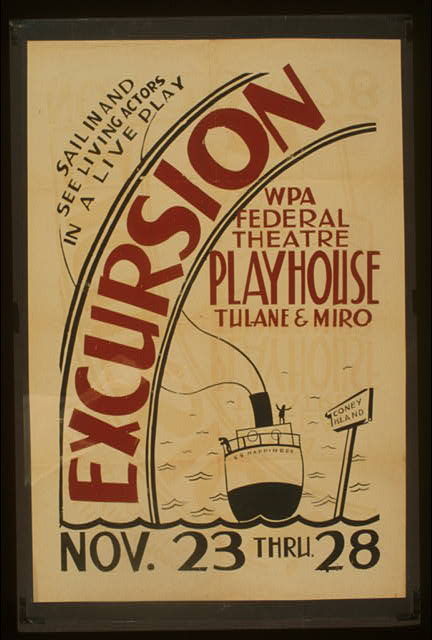
WPA Federal Theatre poster for "Excursion." The Federal Theatre Project put thousands of new actors on stage for the first time. Library of Congress. Public domain.
Step 1: Take a Class
Not because you need a certificate. Because you need a safe place to be terrible.
Acting classes exist so you can experiment, fail, get feedback, and try again without the pressure of a paying audience or a casting director. Every working actor you admire was once the worst person in their class.
What kind of class?
For true beginners: Look for "Introduction to Acting" or "Acting Fundamentals." These cover the basics: script analysis, scene work, improvisation, and emotional availability. Don't start with advanced Meisner or method acting. Walk before you run.
Where to find them:
- Local community colleges (affordable, structured)
- Community theater groups (often free or donation-based)
- Acting studios in your city (more expensive, often better networking)
- Online classes (convenient, but in-person is better for beginners)
What to avoid: Any class that costs thousands of dollars, promises industry connections, or guarantees representation. Legitimate training doesn't need to oversell.
Step 2: Start Watching Differently
You've been watching movies and shows your whole life as an audience member. Now start watching as a student.
When you watch a performance you admire:
- What is the actor doing with their body in this scene?
- Where are they looking? What are they listening to?
- What are they doing in the moments when they're not talking?
- How is this performance different from a similar character in a different show?
The goal isn't to copy. It's to develop your eye for what makes acting specific and truthful versus generic and indicated.
Step 3: Build Your First Monologue
Every actor needs at least two monologues ready: one comedic, one dramatic. These are your calling cards for auditions, class work, and practice.
How to choose:
- Pick characters close to your age and type (for now)
- Pick material you genuinely connect with emotionally
- Avoid overdone monologues (your teacher or a quick search can help with this)
- Keep them under 2 minutes each
- Choose published plays, not movie scripts (theater monologues show range better)
How to prepare:
- Read the entire play, not just your monologue
- Know who you're talking to (monologues are conversations with an absent person)
- Identify what your character wants and what's at stake
- Rehearse out loud, not in your head, until it lives in your body
Step 4: Don't Rush Into Headshots
New actors love to invest in headshots before they're ready. Wait until you've taken a class, done some scene work, and have a sense of your type, the roles you're most likely to be cast in.
When you're ready:
- Budget $200 to $500 for a session (you don't need more)
- Find a photographer who specializes in actors (not models, not family portraits)
- Natural lighting, minimal retouching, multiple looks
- Your headshot should look like you on your best day, not a glamorized version of someone else
Step 5: Get Experience Before You Get an Agent
New actors think the path is: get agent → get auditions → get roles. The real path is: get good → get seen → get representation.
Ways to build experience and credits:
- Community theater. The best low-pressure training ground. You'll learn stage presence, ensemble work, and how to sustain a performance over a run.
- Student films. Film students need actors. Check local film schools, university bulletin boards, and casting websites. These are usually unpaid but give you footage for a reel.
- Independent films. Low-budget indie projects cast through Backstage, Actors Access, and social media. Many accept actors with no credits.
- Improv/sketch groups. Great for comedic actors. Builds spontaneity and ensemble skills.
- Short films you produce yourself. Grab a friend with a camera. Write a 2-minute scene. Shoot it. You learn more by doing than by waiting for permission.
Step 6: Create Your Online Profiles
Once you have a headshot and some experience, set up profiles on the major casting platforms:
- Actors Access. The industry standard. Free basic account, paid submissions.
- Backstage. Good for beginners. Wide range of projects.
- Casting Networks. Strong in commercial casting.
Fill out your profiles completely: headshot, resume, training, special skills. A thin profile with a good headshot still gets you seen. An empty profile gets you nothing.
Step 7: Start Submitting
Don't wait until you feel "ready." You'll never feel ready. Start submitting for roles that match your type and experience level.
What to expect:
- You'll submit for dozens of roles before you hear back from one
- Your first auditions will be nerve-wracking and imperfect
- You might not book anything for months
- This is normal. Every working actor went through this phase.
What to focus on: Each audition is training. Whether you book or not, you're building your audition muscle. The actor who auditions 50 times in a year grows faster than the actor who auditions 5 times.
Step 8: Build Your Skills Daily
The actors who break through aren't the most talented. They're the most consistent. Daily practice, even 15 minutes, compounds over months and years.
What to practice daily:
- Run unfamiliar sides with a reader or scene partner. This builds cold reading skill.
- Work on a monologue. Always have one in progress.
- Read plays. Your understanding of story and character grows with every script you read.
- Watch and study performances. Keep developing your eye.
The Truth About "Making It"
There's no single moment where you "make it" in acting. There's no finish line. There's just a gradual accumulation of skills, experiences, connections, and credits that slowly shifts the balance from "trying to get in" to "building a career."
Some actors book their first role in a month. Some take years. The timing doesn't matter. What matters is whether you're getting better, and whether you keep showing up.
The Federal Theatre Project launched in 1935 and put thousands of people on stage who had never acted before. Many of them went on to significant careers. Their only advantage over you? They started.
Start building your skills with a scene partner →
Image courtesy of the Library of Congress, WPA Poster Collection. Public domain.